You need an AI inventory. A template alone will not keep it true.
Most searches for an AI inventory template are looking for a column layout. The columns are the easy part — you can write them in an afternoon. The hard part is that an inventory is only worth anything if it is still true in six months, and a template has no opinion about that.
Does any rule actually require an AI inventory?
This matters more than it sounds, because a lot of published advice asserts a registration duty that does not exist for most companies. The honest answer has three parts.
No general AI register duty for private deployers
Article 49 of the AI Act governs registration in the EU database. It applies to providers of high-risk systems listed in Annex III, and to deployers that are public authorities or EU bodies. A private company using a high-risk system is not named there. If someone tells you that your company must register its AI systems with Brussels, ask which provision they mean.
But several duties cannot be met without one
| Duty | Who it applies to | What it needs from you |
|---|---|---|
| DORA Art. 28(3) | Financial entities in the EU | A register of all contractual arrangements for ICT services, submitted at least annually. External AI services are ICT services. |
| GDPR Art. 30 | Most organisations | Records of processing activities — which covers any AI system that touches personal data. |
| NIS2 | Essential and important entities | Supply chain and asset management, including the ICT services you depend on. |
| AI Act Art. 26(6) | Deployers of high-risk systems | Retention of automatically generated logs for at least six months. |
| AI Act Art. 4 | Everyone using AI | Sufficient AI literacy of staff — which you cannot target without knowing which systems are in use. |
Quelle: Regulation (EU) 2024/1689 (AI Act), Articles 4, 26 and 49. Regulation (EU) 2022/2554 (DORA), Article 28(3). Regulation (EU) 2016/679 (GDPR), Article 30. Directive (EU) 2022/2555 (NIS2). High-risk obligations under Annex III were postponed to 2 December 2027 and under Annex I to 2 August 2028. · Stand October 2026
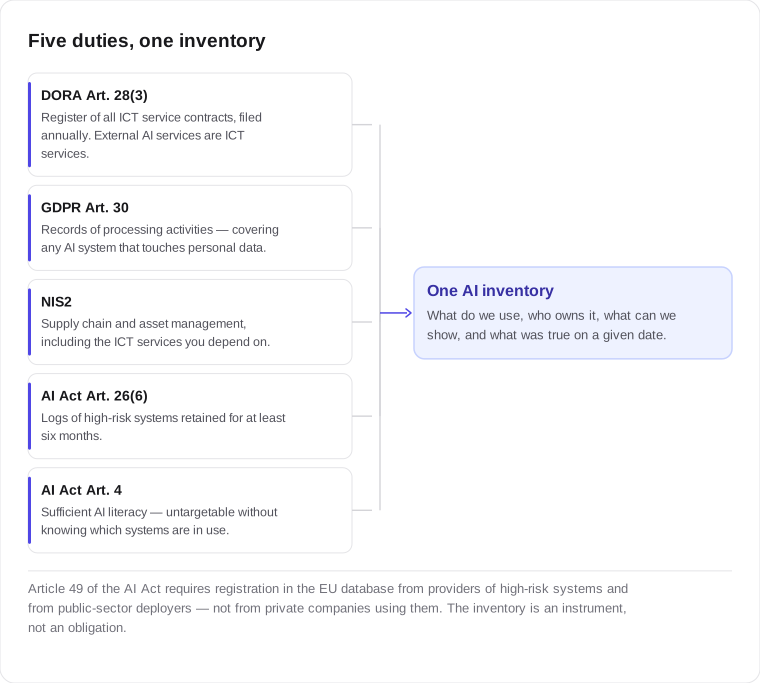
So the inventory is an instrument, not an obligation
That is a better starting point than a compliance checkbox. You are not building it because a regulation names it. You are building it because four separate duties all ask the same underlying question — what do you use, who owns it, and what can you show? — and answering it once is cheaper than answering it four times.
The fields
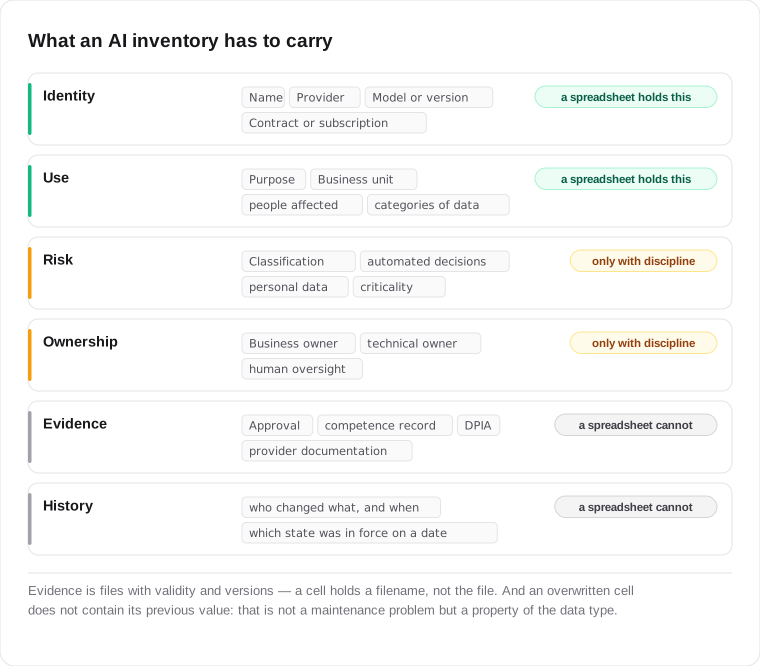
Six groups. The right-hand column is the part most templates leave out: whether a spreadsheet can actually carry that group.
Why the template is the easy part
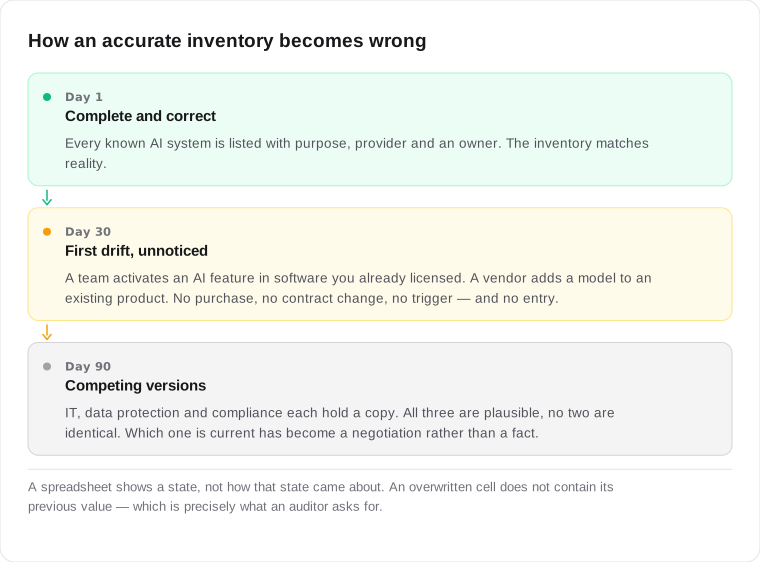
Here is the pattern, and it is remarkably consistent. The inventory is created in a focused week. It is accurate on the day it is finished. Then:
- A team activates an AI feature in software you already licensed. No purchase, no ticket, no entry.
- A vendor adds a model to an existing product. Your contract does not change, so nothing triggers a review.
- Someone leaves, and the owner field still carries their name.
- A risk classification is corrected by overwriting the cell. The previous value is gone.
None of these is negligence. Each one is a change that no mechanism was watching. After two or three months, two departments hold different versions, and the question “which one is current” has become a matter of negotiation rather than fact.
A spreadsheet shows a state. It does not show how that state came about — and the duties above are mostly about the latter.
When a spreadsheet is the right answer
It often is, and saying otherwise would be selling. Use one if all of these hold:
- You are taking stock for the first time and have no overview at all.
- One named person maintains it, not three departments.
- Nobody outside the company has to rely on the result.
- You do not yet need to show what was true at an earlier date.
The line is crossed when a third party has to be able to check the result: a customer in a supplier questionnaire, an auditor, or a supervisory authority. At that point the missing property is not a column. It is the inability to demonstrate that the record was not altered after the fact.
What Regovio does
To be explicit about scope: Regovio does not produce regulatory filings. It is not a DORA submission tool and it does not generate the supervisory templates. It covers the inventory, the assessment and the evidence underneath them.
| Requirement | Regovio | Status |
|---|---|---|
| Inventory of AI assets and workflows | Register with type, lifecycle and relationships | heute verfügbar |
| Ownership per asset | Explicit role assignment, not a text field | heute verfügbar |
| Structured assessment | Personal data, automated decisions, criticality, human oversight | heute verfügbar |
| Evidence as first-class objects | Type, source, validity and versions, linked to the asset | heute verfügbar |
| Change history | Append-only audit log with actor, timestamp and before/after | heute verfügbar |
| Hand something out | Audit export with a SHA-256 manifest per file | heute verfügbar |
| Formatted PDF dossier | Export produces a reproducible package, not a designed document | auf der Roadmap — heute nicht enthalten |
| Regulatory filings, submission files | Not included and not planned | auf der Roadmap — heute nicht enthalten |
A note on language
Regovio is built for the European mid-market, and most of this site is in German — including the contact form. This page is the first of the English track. If you read German, the fuller treatment of the same question is at KI-Register in Excel: wo die Liste aufhört, and the DORA angle at DORA-Informationsregister.